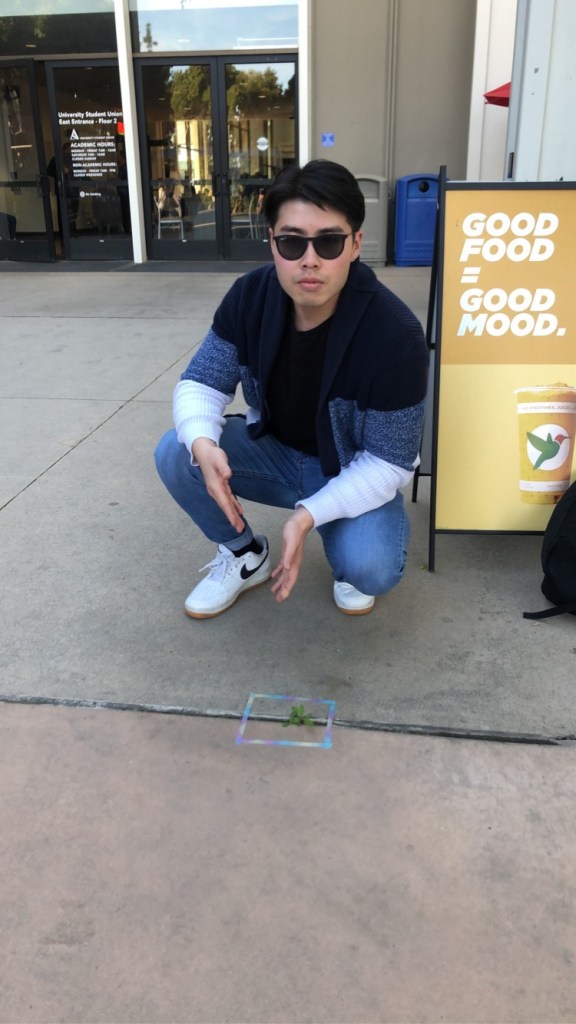
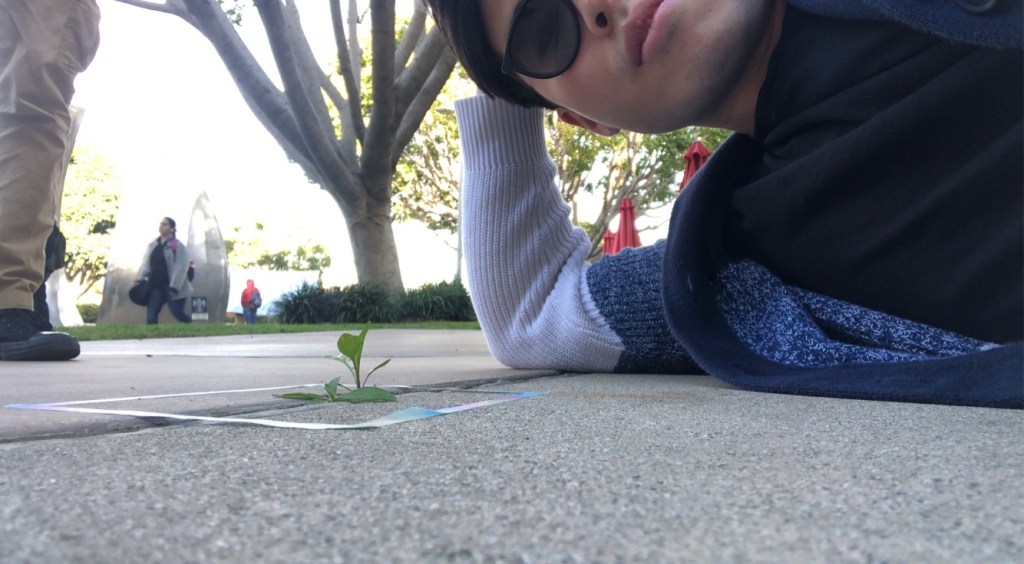
- Down below you will find a collection of my art, including me.
2. Discuss the Form, Aesthetics & Content of your art.
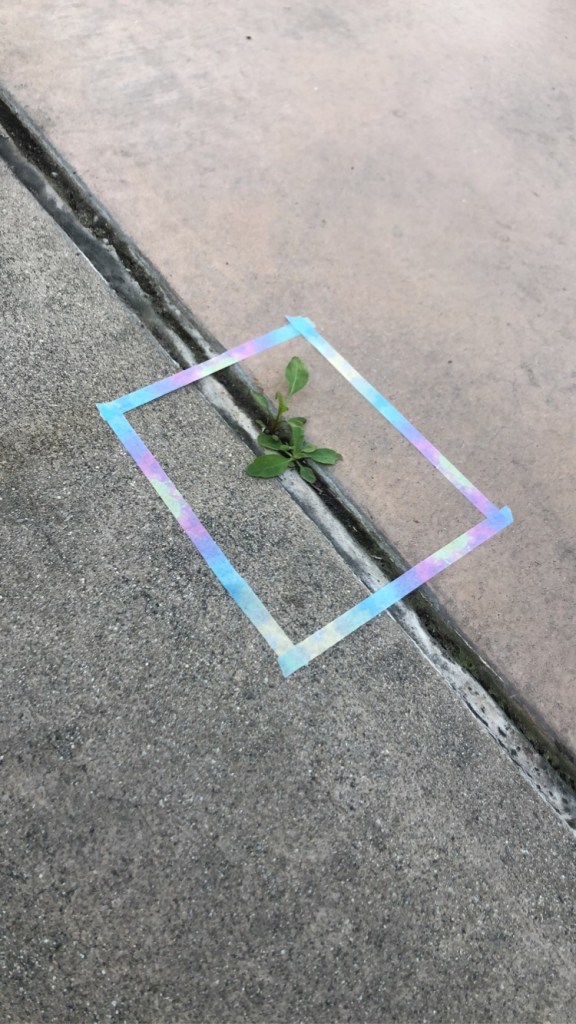
The form of the art is organic and natural. We can see that the piece of art is a plant that has sprouted from the crevice between two slabs of cement. Judging from the size and length of the stem, we can assume that the plant is has had an approximate lifespan of a week or two.
Aesthetically and content wise, we chose this piece of natural artwork due to the juxtaposition of its looks with the profound ideas of life that it portrayed. One of the interpretations that I brought up was looking at the small plant and seeing it for an idea. An idea that you never thought you expected would come to mind. Or possibly something that you were looking for all along, but overlooked it because you were consumed by all the other huge things going on in your life.
3. Was your Art, Art before you put a rectangle around it? Why or why not?/ 4. Will your Art be Art after the rectangle is gone? Why or why not?
Had we not deliberately taken interest in it, it would have been just another plant awaiting death in its surroundings. It definitely was not a piece of artwork like a painting, but what it did was help paint artful concepts, and we were able to find inspiration in our profound contemplation.
We are exposed to art as children in the most simple forms: drawings, colors, sketches, paintings (digital/traditional). Through television and other sources of media/entertainment we find characters and people we like. Gradually, we come to understand feelings of turmoil, anguish, love, happiness, sadness, sorrow, anxiety, depression, and empathy. We take English classes and have teachers that have us explain literary symbolism, imagery, figurative language. We come to learn theory and the scientific way of thinking.
I think most of us in this world come to know Art as it is with experience and enlightenment. We can’t realize what is Art unless we have some foundation of knowledge that we can pull from to connect the strings to form our own unique understanding. So yes, I would say the Art that I have come to experience, will continue to stay a piece of art long after the rectangle was there.
5. Does art reside in the body of the object? So that some objects are art and some objects are not art? Explain. How do we know which objects are art and which are not?
Human anatomy would be a perfect concept to explore with this question. Most objects in and of themselves are just as they are. But I feel it’s what we can take from them and see past is what makes the view a little more colorful. If the object is used/seen with an intent of creativity it can be considered art, however it all we see is just another everyday object for what it is, it’s just that.
6. Can art be something other than an object?
Yes, absolutely. For example, an artist creating and doing things in their own lives don’t automatically make those things art. I work as a barista can consider the coffee I make a work of art. The way I pull my espresso shoots, how I carefully treat/pour my steamed milk, how I layer my foam. These are all things that I purposefully try to perfect and hone and that’s what I believe makes something other than an object art.
7. Does art reside in the experience of the viewer? So that it isn’t an object per se, but a way and a choice of taking the time to have a viewing experience? Explain.
Art doesn’t solely reside in the experience of the viewer, but also the person who decided to create it. But I do think that it is largely in the experience of the person taking the time to understand what they’re perceiving.
 Drew's Visual Art Adventures